


Medical and laboratory equipment often contains complex electronics and precision components that require reliable mechanical protection. Sheet metal offers a cost-effective way to produce robust enclosures, housings, chassis, panels, and brackets without the tooling investment required for high-volume manufacturing.
Low-volume sheet metal fabrication works well for product development, prototypes, and small batches, particularly while designs are evolving and volumes do not justify dedicated tooling.
Sheet metal provides the strength, dimensional stability, and finish required for diagnostic equipment, monitoring systems, and specialised medical devices. Protolis combines sheet-metal fabrication with CNC machining, plastics manufacturing, finishing, and assembly, helping teams manage mixed-technology parts through one coordinated workflow.
Applications of sheet metal for medical equipment
Sheet metal is used for a wide range of structural and protective components in medical and laboratory equipment.
Typical applications include:
- Sheet metal medical enclosures protecting electronics, sensors, power supplies, and other internal components
- Medical equipment housings for diagnostic, analytical and laboratory systems
- Chassis and internal frames supporting PCBs, displays, drives, and other assemblies
- Removable covers and access panels
- Mounting brackets and support components
- Front and rear panels with openings for displays, connectors, switches, and controls
- Protective covers for sensitive components
- Internal shielding and structural components
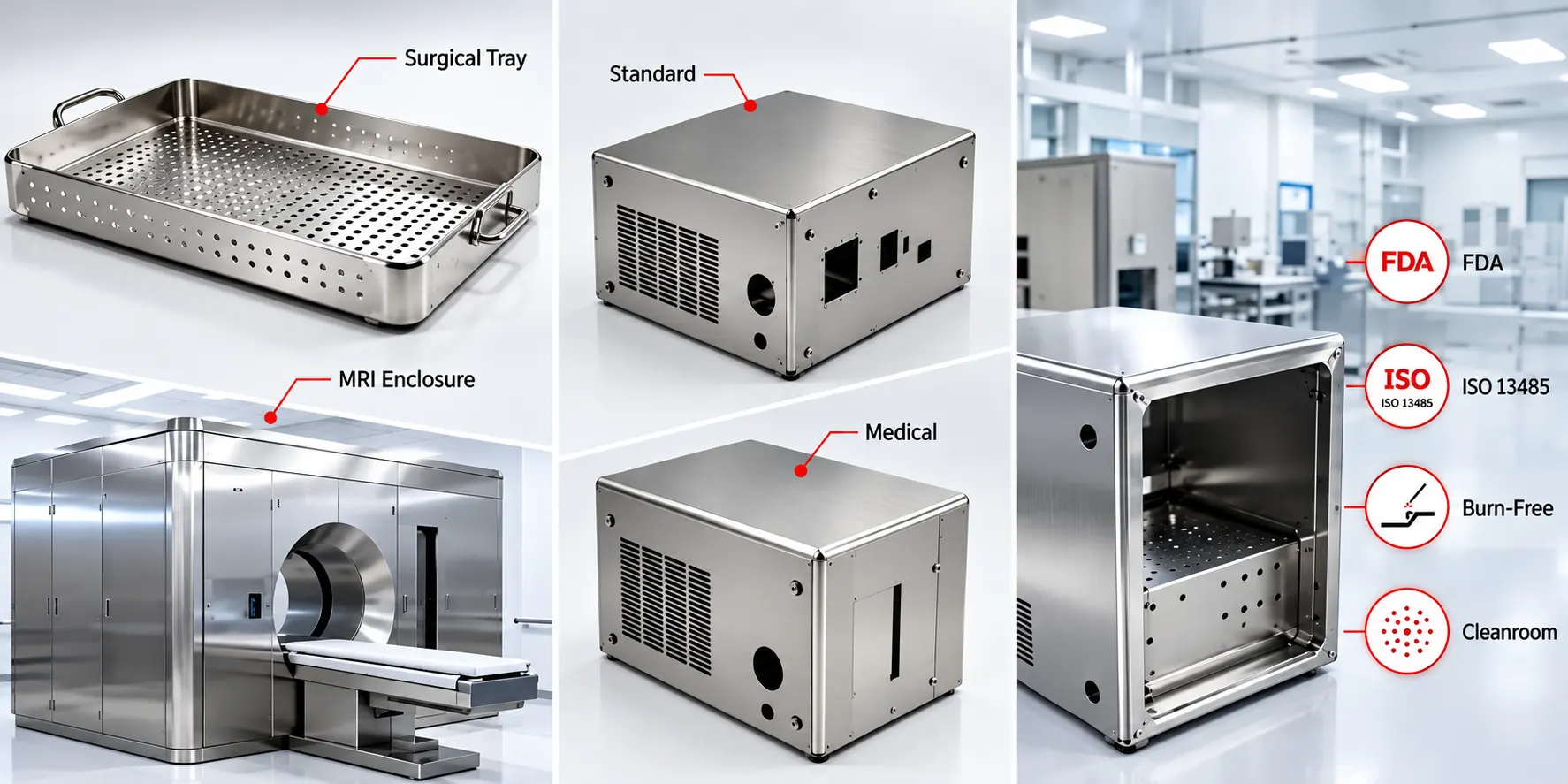
Protolis produces medical device enclosures for healthcare and life-science applications, including diagnostic and testing equipment, laboratory systems, medical lasers, rehabilitation devices, and monitoring equipment.
For equipment that needs assembly, servicing, or upgrades during development, sheet-metal construction allows the housing to be divided into separate covers, panels, and brackets rather than manufactured as a single enclosure.
When should you choose sheet metal?
Sheet metal is well suited for components with mainly flat surfaces, bends, and cut-outs. Laser cutting, punching, and forming create complex parts without a mould, and welding or threading can be added as needed.
Protolis’ sheet-metal services include cutting, forming, welding, threading, and finishing for quantities from one to over 1,000 parts, supporting both prototypes and low-volume production.
For medical sheet metal prototypes, this flexibility lets you make design changes between iterations without the cost or lead time of hard tooling.
Choosing between sheet metal, CNC machining, and plastics depends on geometry, material requirements, and production volume:
- Sheet metal is often a good fit for larger enclosures, chassis, covers, and brackets with relatively thin walls and formed features.
- CNC machining can be preferable for solid components, complex three-dimensional geometries, or parts requiring particularly tight local tolerances. It can also be useful for smaller housing components and interfaces.
- Plastic manufacturing can offer advantages where low weight, electrical insulation, transparency, or moulded three-dimensional forms are important. Processes such as vacuum casting and injection moulding become increasingly attractive as quantities and design requirements change.
The manufacturing method should be considered during product design, not after the geometry has been finalised. Selecting the process early helps balance functionality, lead time, unit cost, and the likelihood of further design changes.
Material selection for medical sheet metal fabrication
Material selection should reflect the equipment’s operating environment as well as its mechanical, cosmetic, and manufacturing requirements.
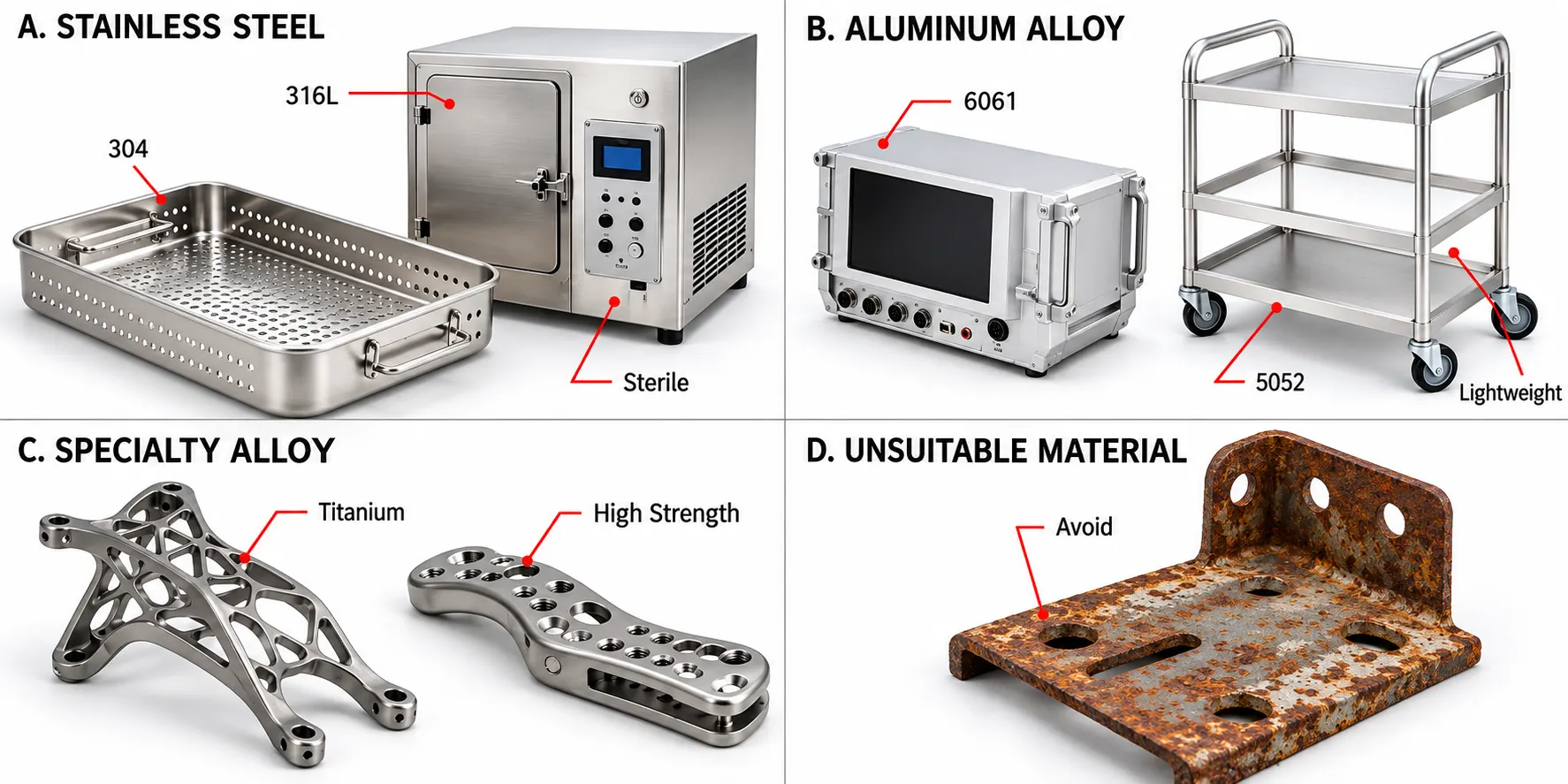
Stainless steel
Stainless steel is often chosen when corrosion resistance, durability, and a robust appearance are priorities. It can suit equipment exposed to repeated cleaning or disinfection, provided the selected grade and surface finish are compatible with the cleaning agents and conditions used.
For larger medical equipment housings, stainless steel offers high stiffness, durability, and corrosion resistance. Confirm the grade, thickness, and finish against mechanical requirements, cleaning processes, and fabrication methods during quotation.
Aluminium
Aluminium combines low weight, strength, and corrosion resistance. Reducing enclosure weight is especially important for portable or mobile medical and laboratory equipment.
Aluminium can be anodised or finished to achieve a particular appearance or functional surface. Protolis offers various aluminium grades, including 1050 and 6061, among its sheet-metal material options.
Select materials based on the complete application, not individual properties in isolation. Assess weight, stiffness, corrosion resistance, cleaning, appearance, electrical requirements, fabrication method, and total cost together.
Medical sheet metal design considerations
Effective medical sheet metal design starts with the manufacturing process. Even small CAD changes can significantly affect manufacturability, assembly, and cost.
For more detailed guidance on designing sheet-metal components, consult Protolis’ sheet metal manufacturing guide.
Sheet thickness and bends
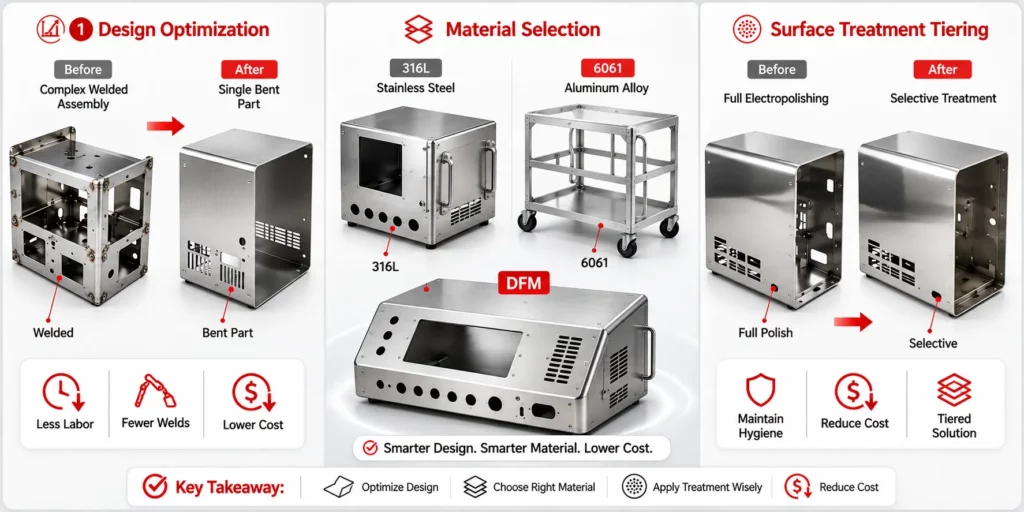
Thickness depends on component size, mechanical loads, stiffness requirements, and material. Bends add rigidity without increasing thickness, making formed sheet efficient for chassis and enclosures.
Consider bend radii, minimum flange dimensions, and bend relief early in the design. Holes or cut-outs near bends may distort during forming, and closely spaced bends can restrict tooling and forming sequence.
Holes and cut-outs
Check hole size, spacing, and position against sheet thickness, tooling, and forming sequence. Ensure cut-outs for displays, connectors, fans, and cables provide enough clearance for manufacturing and assembly.
For panels that will be removed frequently, ensure technicians can access screws, hardware, threaded features, and connectors without disassembling unrelated components.
Fastening, welding, and assembly
Sheet-metal assemblies can use screws, threaded inserts, self-clinching fasteners, tabs, slots, and other joining methods. Welding is suitable for permanent or load-bearing joints, but heat distortion and its effect on mating surfaces must be considered.
Select the assembly method based on whether the enclosure will be permanently assembled, regularly opened for maintenance, or designed as a modular system.
Tolerances and service access
Tight tolerances are not necessary on every dimension. Applying them where they add no functional value increases manufacturing cost without improving the final product.
Identify critical interfaces, such as mounting locations, display openings, connector positions, and mating surfaces, and set tolerances accordingly.
Plan maintenance access during design. The housing should allow technicians to inspect, replace, or adjust components without dismantling unrelated assemblies.
Surface finishes and cleaning requirements
Surface finish affects appearance, corrosion and wear resistance, and cleaning compatibility. Enclosure geometry also impacts cleanability, as seams, recesses, exposed fasteners, and inaccessible joints can retain residues or contaminants.
Depending on the application, sheet-metal parts may need painting, powder coating, or other finishes. Aluminium parts can be anodised if compatible with the alloy and process. Confirm availability of finishing options for your selected material and process.
Define the intended cleaning regime before selecting a finish, and distinguish clearly between cleaning, disinfection, and sterilisation:
- Cleaning removes dirt, residues, and other contaminants from a surface.
- Disinfection uses physical or chemical methods to reduce or eliminate harmful microorganisms.
- Sterilisation is a more stringent process intended to eliminate all forms of viable microbial life.
Enclosures needing only routine cleaning have different requirements than those exposed to hospital-grade disinfectants or sterilisation processes.
Select the finish based on the actual cleaning chemicals, concentrations, temperatures, exposure times, and frequency expected in use. Protolis offers coatings resistant to hospital-grade disinfectants, but compatibility should be confirmed for your specific conditions.
Do not assume a material or coating is suitable for sterilisation simply because it is labelled for medical equipment. Always consider the full application and validated cleaning or sterilisation process.
From prototype to small-batch production
One advantage of sheet metal is that the process used for initial parts can often continue into low-volume production, reducing or avoiding redesign.
The process starts with a 3D CAD model and a 2D manufacturing drawing that specifies critical dimensions, tolerances, materials, and finishes. The manufacturer reviews the design for issues such as bends, holes, welding, hardware, tolerance accumulation, finishing, and assembly.
This design-for-manufacturing review identifies practical issues before they affect larger production runs.
The first parts can then be used for:
- Dimensional verification
- Fit and assembly checks
- Integration with electronics and other components
- Evaluation of access panels and fasteners
- Cosmetic and surface-finish approval
- Functional testing of the complete equipment
After design validation, repeat orders use the approved geometry and specifications. This is especially useful for low quantities or products still in engineering and market validation.
Quotation requirements and quality control
A complete quotation package enables Protolis to assess manufacturability, identify risks, and provide accurate pricing and lead times.
For sheet-metal medical equipment components, customers should ideally provide:
- 3D CAD files in a suitable format
- Fully dimensioned 2D drawings where required
- Material and material grade
- Sheet thickness
- Surface-finish requirements
- Critical dimensions and tolerances
- Assembly requirements
- Fastener or threaded-feature specifications
- Welding requirements, if applicable
- Required quantity and target delivery date
- Inspection plan, sampling requirements, and required documentation
Clearly distinguish critical dimensions from general ones. Indicate any specific functional requirements for connector openings, mounting hole patterns, or mating surfaces on the drawing.
Protolis supports repeatable production quality for medical and laboratory equipment through ISO 9001 and ISO 13485-certified quality management, from prototypes to small-batch production. Quality documentation may include inspection reports, photographs, videos, material certificates, certificates of conformity, and REACH or RoHS documentation. Define inspection, traceability, and documentation requirements during quotation to ensure proper quality controls from the start.
Medical sheet metal fabrication with Protolis
Sheet metal offers a practical path from early functional prototypes to repeatable small-batch production for medical and laboratory equipment manufacturers.
Early manufacturing input helps teams optimise bend geometry, fastening, tolerances, surface finish, and cleaning compatibility before these decisions add unnecessary cost, extend lead time, or create assembly risks.
Protolis combines sheet-metal fabrication with rapid prototyping and low-volume manufacturing, supporting projects from design review to production. For an example of our approach to enclosure development, see the custom medical equipment enclosure case study.
Ready to discuss your next medical equipment project? Submit your CAD files and specifications to Protolis for a quotation and manufacturing review.
FAQs
What is medical sheet metal fabrication?
Medical sheet metal fabrication involves producing metal enclosures, housings, chassis, brackets, and other components for medical and laboratory equipment. Typical processes include cutting, bending, punching, welding, threading, and surface finishing.
Is sheet metal suitable for medical device prototypes?
Yes, sheet metal is well suited to functional prototypes because many parts can be manufactured without dedicated hard tooling. Designs can therefore be tested and modified before moving to pilot runs or small-batch production.
What materials are used for sheet metal medical enclosures?
Common choices include stainless steel, aluminium, and coated steel, depending on required corrosion resistance, weight, strength, and finish. Copper and brass may also be used for specialised electrical, thermal, or shielding applications.
What tolerances can be achieved with sheet metal fabrication?
Achievable tolerances depend on the material, thickness, geometry, and number of bends. Protolis generally works to ISO 2768 class c and reviews 2D drawings separately when tighter or function-critical tolerances are required.
How long does sheet metal prototyping take?
Lead time depends on design complexity, material availability, and finishing and post-processing requirements. Protolis can deliver sheet metal medical housing parts up to 500 × 500 × 500 mm within five days of drawing approval.
What low-volume sheet metal fabrication processes does Protolis offer?
Protolis offers laser, waterjet and plasma cutting, as well as bending, punching and deep drawing. Additional operations include welding, threading, assembly, and a range of cosmetic or protective finishes.
What sheet metal part sizes and production quantities can Protolis support?
Protolis supports orders ranging from a single prototype to more than 1,000 parts, with a maximum part size of 500 × 500 × 500 mm. Available materials include aluminium, steel, stainless steel, brass and copper, with more than eight finishing options.